 FA
FA
The expansion of economic relations between Iran and China in recent years has created a favorable environment for Iranian enterprises to operate in the Chinese market. A thorough understanding of China’s legal system and the statutory requirements for company formation constitutes the essential prerequisite for achieving success and ensuring the continuity of commercial presence in the country.
The purpose of this paper is to examine the legal framework and administrative procedures governing the establishment of Iranian companies in China. It also introduces the regulatory authorities and practical considerations that Iranian companies must take into account prior to entering the Chinese market.
General Framework of Foreign Investment Law in China

Foreign investment constitutes one of the principal pillars of China’s economic development over the past four decades. Since the implementation of the “Open Door Policy” in 1978, China has gradually become one of the world’s largest destinations for foreign capital, continuously reforming and modernizing its legal infrastructure to attract and protect international investors.
China’s current investment legal regime is founded upon a consolidated and modern statute formulated to ensure equal treatment between domestic and foreign investors, administrative transparency, and the protection of private property rights. This legal framework, while preserving China’s economic sovereignty and national security, seeks to strike a balance between attracting foreign investment and safeguarding domestic interests.
From a legal perspective, market entry into China for foreign investors—including Iranian entities—requires a comprehensive understanding of the fundamental regulations, permissible forms of legal presence, and the incentives and restrictions imposed by the Chinese government across various sectors. Knowledge of this structure is the first step towards designing an effective market-entry strategy, drafting partnership agreements, and establishing subsidiaries.
The general framework governing foreign investment in China may be analyzed in three principal dimensions:
Legal foundations and supervisory authorities
Forms of foreign investment presence
Incentives and restrictions applied by the government
Legal Foundations
The legal regime for foreign investment in China is based on the comprehensive “Foreign Investment Law of the People’s Republic of China,” effective as of January 1, 2020. This statute is the culmination of over forty years of incremental reforms in the area of foreign investment and replaced the three previously fragmented laws concerning equity joint ventures, cooperative joint ventures, and wholly foreign-owned enterprises.
The primary objective of the new law is to unify the legal approach toward foreign investors, enhance transparency and legal certainty, and align China’s investment regime with international standards. The law introduces core principles such as national treatment for foreign investors, protection of intellectual property and foreign capital, and administrative transparency in government decision-making.
Under this law, the Chinese government undertakes not to nationalize or expropriate foreign investment except upon payment of fair compensation and guarantees the free remittance of profits and capital abroad in compliance with foreign exchange regulations. Furthermore, foreign investors are granted equal rights to participate in the formulation of standards, regulations, and administrative procedures directly related to investment.
Supervision over the implementation of this law and China’s foreign investment policy is exercised primarily by three authorities:
The Ministry of Commerce (MOFCOM), which reviews, approves, and registers foreign investment projects and issues the relevant catalogues of permitted and prohibited industries;
The State Administration for Market Regulation (SAMR), which registers companies, issues business licenses, regulates corporate names, and oversees mergers and structural changes;
The National Development and Reform Commission (NDRC), which formulates macroeconomic investment policies and publishes the annual “Negative List for Foreign Investment.”
In addition, local governments particularly within Free Trade Zones and industrial cities—are vested with the authority to issue permits and offer incentives to foreign investors. This multi-tier regulatory structure has resulted in a transparent yet dynamic system, where national and local regulations operate in coordination.
Forms of Foreign Investor Presence
China’s Foreign Investment Law allows foreign investors, including Iranian entities, to choose from several legal forms for establishing a business presence. The choice of legal form directly affects management control, operational scope, profit distribution, and compliance obligations.
Wholly Foreign-Owned Enterprise (WFOE): this is the most common form of foreign-invested enterprise. All shares and capital are owned by the foreign investor, granting full managerial autonomy. A WFOE may engage in manufacturing, trading, consulting, technology, or export operations. Its principal advantage lies in full control without the need for a Chinese partner, although certain industries still require local participation.
Joint Venture (JV): formed between one or more foreign investors and one or more Chinese partners, classified as either an Equity Joint Venture (EJV) or a Cooperative Joint Venture (CJV). EJVs allocate equity and profit proportionate to capital contribution, while CJVs follow contractual arrangements for profit-sharing. JVs are particularly suitable for investors entering restricted industries or seeking access to local distribution networks or land use rights.
Representative Office (RO): these offices are not separate legal persons but extensions of the parent company. They are limited to non-commercial activities such as market research, liaison, and contract supervision. They cannot engage in direct business or issue invoices. Nonetheless, ROs serve as a cost-effective preliminary presence for companies exploring the market.
Foreign-Invested Partnership Enterprise (FIPE): permitted in recent years, offering flexibility for smaller-scale or short-term projects that do not require incorporation of a separate entity.
Incentives and Restrictions
To attract foreign investment, China implements a combination of targeted incentives and statutory restrictions based on national development priorities and industrial policy.
Incentives include corporate income tax reductions from 25% to 15% in free trade zones and designated cities, customs exemptions for imported production equipment, facilitation of profit repatriation, and preferential land-use rights. Priority sectors such as high technology, renewable energy, biotechnology, e-commerce, logistics, and modern urban services enjoy special support policies. Local governments may offer additional tax holidays and infrastructure assistance.
Conversely, restrictions apply in sectors linked to national security, culture, or strategic resources, as listed annually in the Negative List for Foreign Investment, jointly issued by MOFCOM and NDRC. Prohibited or restricted industries include media and publishing, defense, education, extraction of sensitive natural resources, and activities involving critical data.
All foreign-invested entities must comply with reporting and compliance obligations, including submission of annual financial and operational reports and registration of any changes in ownership or management. China has digitized these processes to increase transparency and efficiency for foreign investors.
Legal Forms Available to Iranian Companies in China

Iranian investors intending to conduct commercial, industrial, or service activities in China must first select a legally recognized investment structure. The chosen structure determines the degree of managerial control, tax obligations, business scope, and profit transfer feasibility. The three principal forms applicable to Iranian investors are:
Wholly Foreign-Owned Enterprise (WFOE)
A WFOE allows full ownership and independent management by the Iranian investor. It grants autonomy in corporate structure, staffing, and operational strategy while enabling direct contracting and eligibility for local tax privileges.
The establishment process involves approval of the business plan by MOFCOM, name registration with SAMR, opening of a corporate bank account, capital verification, obtaining tax registration, and issuance of the company’s official seal (chop).
Chinese–Iranian Joint Venture (JV)
A JV combines the resources and expertise of Iranian and Chinese partners through either an EJV or CJV arrangement. The JV agreement must clearly specify capital contribution, board composition, management authority, dispute resolution mechanism, and profit distribution.
While JVs facilitate entry into restricted industries and leverage local networks, they require meticulous coordination, trust, and transparent governance to avoid managerial conflicts.
Representative Office (RO)
An RO serves as a preliminary form of market presence without legal personality. It cannot generate income or conduct transactions but may promote the parent company and undertake market research. Establishment requires submission of corporate certificates, financial statements, and designation of the chief representative. The RO’s expenses must be funded exclusively by remittances from the parent company.
Procedures for Company Registration in China
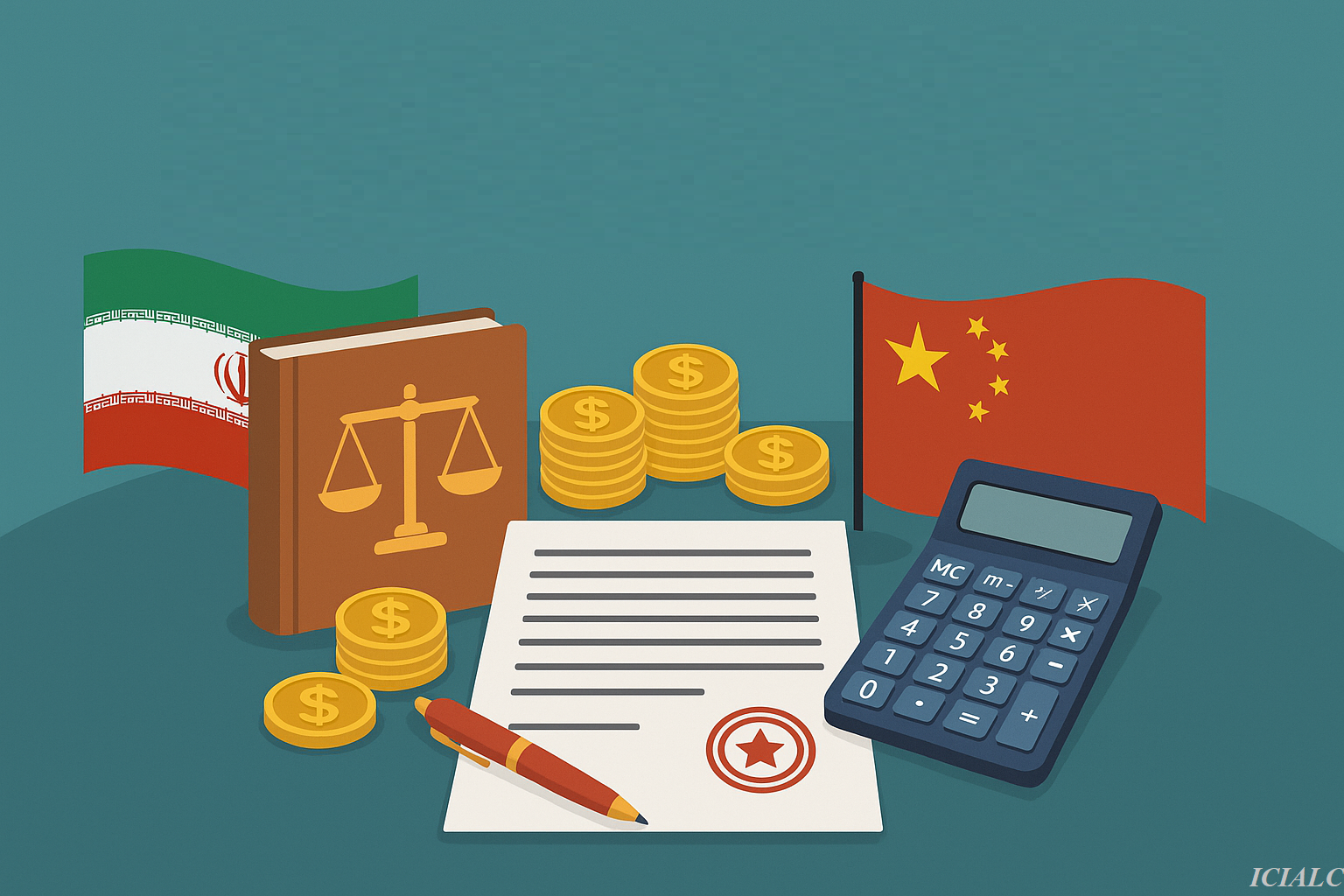
Despite administrative complexity, the process of company formation in China is transparent and predictable when legal requirements are properly met. The steps are summarized as follows:
Determine the legal form and business scope in compliance with the Negative List.
Prepare a Feasibility Study Report, containing investment structure, objectives, and operational plans.
Reserve the company name via SAMR’s online system.
File incorporation documents (Articles of Association, Joint Venture Contract if applicable, directors’ and shareholders’ IDs, and office lease) to obtain the Business License.
Open a bank account and inject the registered capital with authorized Chinese banks.
Register for taxation with the State Taxation Administration (STA) and apply for any special licenses required by industry-specific regulators.
Register for social security and employment of staff, including work permits for expatriates.
Obtain the company seal (Company Chop), the official legal signature for all business acts.
Commence operations and complete annual reporting obligations to MOFCOM and SAMR.
Collaboration with local legal advisors significantly accelerates and secures this process, especially for Iranian companies, which may benefit from the services of the Iran–China International Arbitration and Legal Center.
Legal and Tax Compliance for Iranian Companies in China

After incorporation, full observance of China’s legal, tax, and regulatory obligations becomes imperative.
Legal Compliance
All foreign-invested enterprises must operate in accordance with China’s general commercial laws and MOFCOM administrative rules. Major corporate changes such as alteration of directors, capital changes, or relocation must be reported to SAMR within the statutory deadline. Annual online reporting to MOFCOM ensures sustained compliance oversight.
Chinese labor laws impose strict requirements regarding employment contracts, minimum wage, insurance, and working hours, with potential civil or criminal liability for non-compliance.
Tax System and Fiscal Obligations
Foreign-invested companies are subject to:
Corporate Income Tax (CIT): standard 25%, reduced to 15% in eligible zones or priority sectors.
Value-Added Tax (VAT): 6–13% depending on goods or services, filed monthly through the STA system.
Withholding Tax on profit repatriation: 10% in absence of a Double Taxation Agreement (DTA). Since no DTA exists between Iran and China, Iranian investors must account for this tax in their financial planning.
Auditing, Reporting, and Foreign Exchange Control
Annual financial statements must be audited by licensed Chinese auditors. The State Administration of Foreign Exchange (SAFE) regulates capital transfers abroad, requiring proof of tax clearance prior to remittance. Iranian companies may face additional scrutiny in banking transactions due to international compliance considerations.
Protection of Intellectual Property Rights
Iranian companies should register their trademarks and relevant IP with the China National Intellectual Property Administration (CNIPA). China follows the “first-to-file” principle—therefore early registration is crucial. Patents, industrial designs, and proprietary software should also be protected.
Dispute Resolution and Arbitration
Disputes are commonly resolved through negotiation, mediation, or arbitration. The China International Economic and Trade Arbitration Commission (CIETAC) is the primary body for international commercial arbitration.
Contracts should explicitly designate the arbitration body, governing law, language, and seat of arbitration. The Iran–China International Arbitration and Legal Center can assist in drafting compliant and balanced arbitration clauses.
Conclusions and Legal Recommendations for Iranian Enterprises in China

Understanding the Legal Framework
Before entering the Chinese market, Iranian companies must thoroughly study the regulations of MOFCOM, SAMR, and SAFE, and select the most suitable structure—WFOE, JV, or RO—based on strategic and operational needs.
Ensuring Legal and Tax Compliance
Timely submission of annual reports, accurate payment of taxes (CIT/VAT), and full registration transparency are essential to avoid penalties or suspension. Considering Iran’s banking constraints, maintaining complete financial documentation and working with licensed Chinese accountants is strongly advised.
Registering Trademarks and Protecting IP
Immediate trademark registration with CNIPA is imperative. Failure to do so may result in local parties registering identical marks and restricting usage.
Drafting Detailed Contracts and Arbitration Clauses
All commercial agreements should specify the applicable law, official contract language, and arbitration forum—preferably CIETAC or a joint Iran–China arbitration institution—to ensure procedural predictability and enforceability.
Engaging Specialized Legal Counsel
Due to regional variations in regulatory application, cooperation with qualified local law firms and the Iran–China International Arbitration and Legal Center is recommended for legal feasibility analysis, corporate registration, contract drafting, and dispute management.
Final Remark
China’s vast consumer base, sustained growth, and investor-friendly policies present significant opportunities. However, success requires precise legal compliance, structured tax management, and strategic use of international arbitration mechanisms. Iranian companies adopting a legally disciplined and adaptive approach can achieve sustainable development and reinforce bilateral economic cooperation between Iran and China.